

How Many Sets Do You Need to Build Muscle?
Understanding training volume, diminishing returns, and when to do more.
By Coach Jasper · OnPlan Coaching
You finish your workout, check the time, and wonder whether you have done enough.
Would another exercise help? Should you add a fourth set? If someone online trains twice as much as you, does that mean you are getting half the results?
These questions are understandable. Training takes effort, and you want that effort to count. But judging a programme by the length of the workout or the number of exercises leaves out an important question: is the work helping you make progress?
Here is how to think about training volume—and how to decide when changing it might help.
First, what does training volume mean?
For this article, we will describe volume mainly as the number of working sets you perform for a muscle across a week.
A rep is one repetition of an exercise. A set is a group of repetitions performed before resting. A working set is one of the main sets in your programme, after any preparation or warm-up sets.
If you perform three working sets of a chest press on Monday and three on Thursday, that adds up to six weekly chest-press sets. Your chest may also receive work from other exercises, which we will discuss later.
Notice that this is:
- Per muscle, rather than the total sets in your workout.
- Across the week, rather than just one session.
- Working sets, rather than every warm-up set.
Also separate volume from load, which is the weight you lift, and effort, which describes how demanding the set is. Three sets with a weight you could comfortably lift many more times are a different experience from three challenging sets with that same weight.
More can help, but the benefits get smaller
A large research analysis found that higher weekly set volumes were associated with greater average muscle growth, with diminishing returns.[1]
Think of it this way: adding some useful work to a small amount of training may make a meaningful difference. Adding the same amount to an already substantial programme may offer a smaller improvement.
That matters when choosing how to spend your time. You might happily invest extra gym time for a possible additional benefit. Someone balancing training with children, work, and travel might prefer a smaller commitment they can sustain.
Neither person needs to treat workout length as a scorecard.
The research also does not give us permission to keep adding sets indefinitely. A positive average relationship within the available evidence is not a promise that every extra set helps every person.
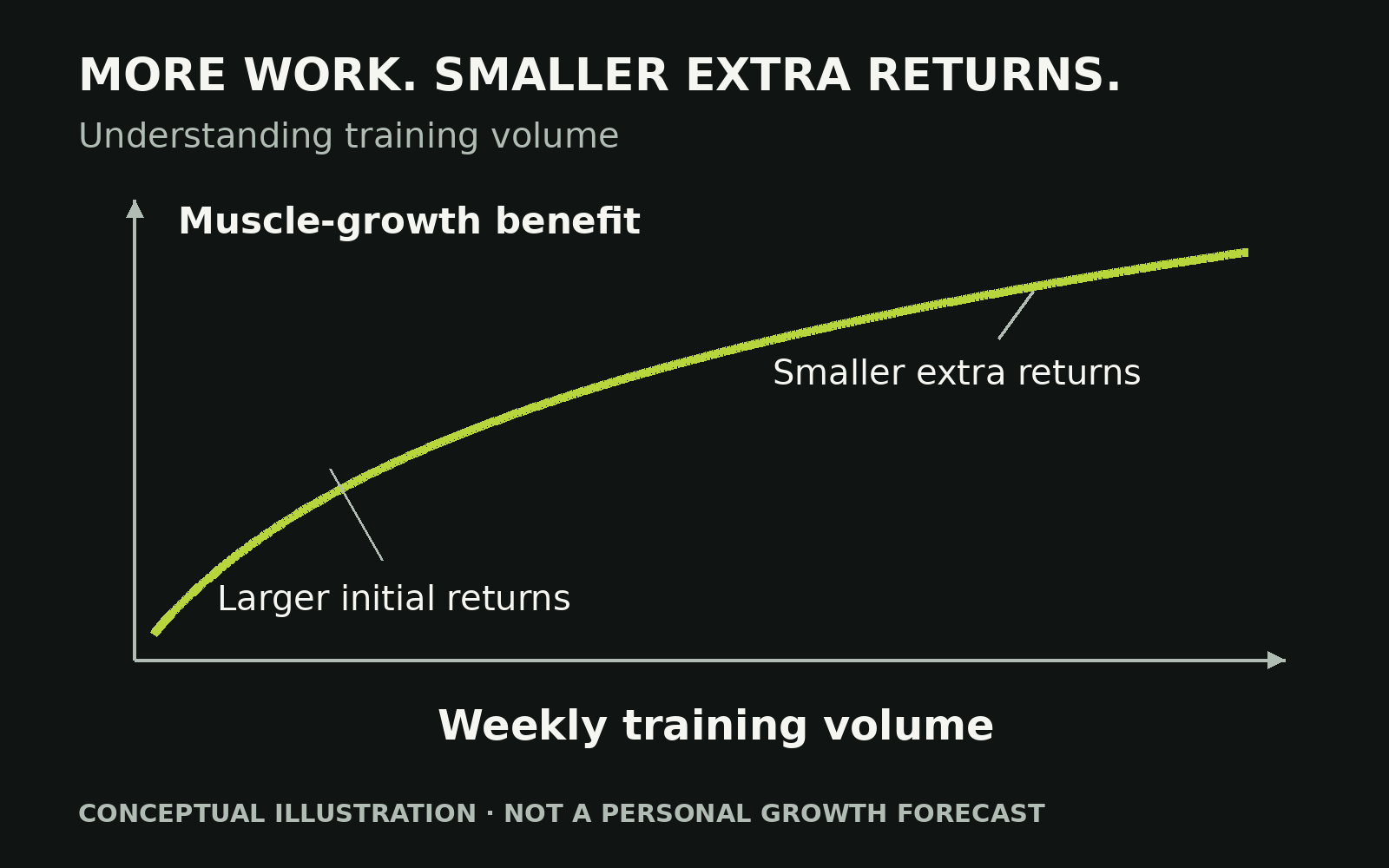
Conceptual illustration of diminishing returns—not a personal growth forecast. Informed by Pelland and colleagues; see reference 1.
What makes a set worth doing?
Counting sets becomes more useful when you also consider how they are performed.
For practical purposes, I would look for an exercise you can perform consistently, movement you can control, and an appropriate level of challenge for the goal and your experience.
One way to describe effort is repetitions in reserve, or RIR: how many more repetitions you estimate you could complete before you cannot finish another repetition with the intended technique.
For example, you complete ten repetitions and believe you could have managed another two. That is approximately 2 RIR.
Research suggests that ending sets closer to muscular failure can matter for muscle growth, although the exact relationship remains uncertain.[3] This does not mean every set must end with a failed repetition. An eight-week study found similar quadriceps growth when trained participants stopped approximately one or two repetitions short of failure compared with reaching failure; the failure condition produced greater acute fatigue.[4]
For many exercises, leaving a small number of repetitions in reserve can be a useful coaching target. Beginners may need time and feedback to judge this accurately. On unfamiliar movements, learning to control the exercise can take priority over testing your limit.
Before adding more sets, check whether the current sets provide the intended challenge.
A manageable starting point
There is no single weekly number that everyone must reach before muscle growth can happen.
ACSM’s current guidance highlights roughly ten sets per muscle group per week when the goal is hypertrophy—the technical term for muscle growth.[2] Treat that as a useful reference point, not a pass mark or a personalised prescription.
For a healthy beginner learning to train, around six to ten purposeful weekly sets for a priority muscle can be a practical range to discuss with a coach. This is a coaching starting framework, not a scientifically established optimum. Some people may appropriately begin below it; others may already tolerate and benefit from more.
Here is an example of the arithmetic, rather than a complete programme:
| Session | Chest-focused exercise | Working sets |
|---|---|---|
| First session | Chest press | 3 |
| Second session | Chest press or another suitable chest exercise | 3 |
| Weekly total | Across the two sessions | 6 |
That does not tell us whether six is ideal. It gives us a clear starting point to evaluate. It also shows why “three sets” is incomplete information without knowing the weekly schedule.
You do not need to assign every muscle the same number. Your priorities, exercise choices, and the work muscles receive indirectly all affect the programme.
Should you keep, add, or reduce your sets?
Use a training log to record exercises, weights, repetitions, and how demanding the sets felt. Review patterns across several weeks, rather than reacting to one difficult session.
| What you notice | A sensible next step |
|---|---|
| You are gradually doing more repetitions or lifting more with comparable technique and effort, and the programme feels manageable | Keep the workload steady. There is no obligation to add sets simply because you can. |
| Progress has stalled across several comparable sessions, but attendance, effort, and recovery are reasonably consistent | Review the programme. A small increase for a particular muscle may be one option. |
| Workouts frequently overrun or you regularly skip the final exercises | Simplify the plan or redistribute the work before increasing the workload. |
| Performance repeatedly declines and you feel persistently under-recovered | Review training and life demands. A temporary reduction may be appropriate. |
| An exercise repeatedly causes pain | Discuss it with your coach and seek appropriate assessment when needed; do not assume adding or subtracting sets addresses the cause. |
Performance is useful feedback, but it is not a direct measurement of muscle growth. Better technique and familiarity can also improve your lifts. Consider it alongside your goals, longer-term changes, and how well you are tolerating the plan.
If an increase makes sense, one practical experiment is to add one or two weekly sets for the muscle being prioritised, keep other variables reasonably consistent, and review what happens. This is a way to make an adjustment easier to evaluate, not a research-proven rule about the perfect increment.
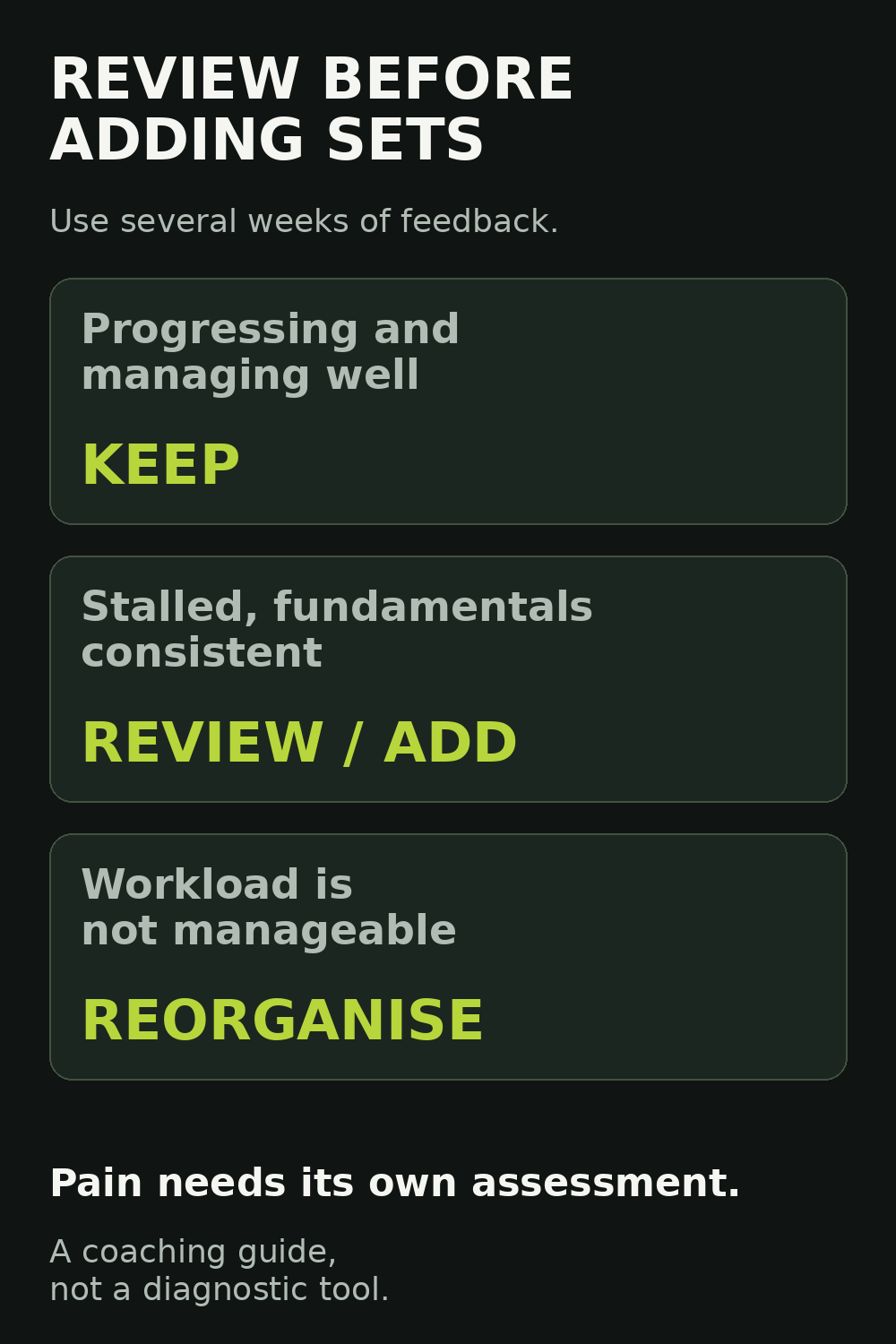
Use the table above for the full explanation. This graphic is a coaching guide, not a diagnostic tool.
A plateau deserves more than an automatic volume increase
If you told me, “I am not progressing, so I think I need more sets,” I would want to understand what has been happening first.
Are the sessions being completed? Have the exercises changed repeatedly? Are you resting enough to perform the next set as intended? Are you comparing sets performed with similar technique and effort? Has sleep, food intake, stress, or your work schedule changed?
Those questions help identify what to adjust.
For example, suppose you are scheduled to do three sets but regularly rush the last two because you are short on time. Adding a fourth set does not address that scheduling problem. A shorter session or a different arrangement may be more useful.
Or perhaps you finish every set easily because the weight has not changed as your ability has improved. We would review the challenge of those sets before assuming the programme needs more of them.
These are illustrative situations, not client case studies. They show why the same complaint can lead to different coaching decisions.
Fit the training to the life you actually have
Imagine two people with different priorities.
The first can train twice a week and wants to become stronger, build some muscle, and feel more capable. A sensible plan should make those two sessions productive and repeatable. Its success should not depend on finding several extra gym days.
The second enjoys training, already has a consistent routine, and wants to prioritise a particular muscle. They may choose to allocate more work to it, while adjusting other parts of their programme to keep the total commitment manageable.
The aim is to make the trade-off deliberate. Extra work should have a purpose that matters to you.
Want the details? How to read the volume research
Direct and indirect sets
An exercise can train several muscles. A chest press involves the chest and also the triceps, while a triceps extension targets the triceps more directly.
The volume analysis used a fractional approach: indirect sets were counted as half a set and direct sets as a full set.[1] Under that accounting method, six pressing sets plus four triceps-extension sets would contribute an estimated seven triceps sets: three from pressing and four from extensions.
This is a modelling convention, not a measurement proving that every pressing set delivers exactly half the triceps stimulus of an extension. It helps explain why copying somebody’s direct-set count can overlook other work in their programme.
Weekly volume and training frequency are different
Volume describes how much work you perform. Frequency describes how often you train.
The same six weekly sets can be organised across different sessions. The analysis found that frequency’s independent relationship with muscle growth was less clear than its relationship with strength.[1] It does not follow that the number of sessions never matters to an individual. How the sessions fit your schedule remains a practical consideration.
An average curve is not your personal forecast
The analysis combined 67 studies involving 2,058 participants; about 79% were male, with an average age around 25.[1] That is useful context when applying the findings to a varied coaching clientele.
A meta-regression looks for patterns across study results. It does not establish what would happen if you personally changed one variable while everything else stayed the same. Studies also differ in their participants, exercises, duration, and measurement methods.
Use the research to inform a starting decision. Use consistent training and follow-up to determine what needs adjusting for you.
How coaching helps you put this into practice
You can use these principles to make more informed decisions about your own training.
If you would like support applying them, that is where coaching can help: choosing a sensible starting workload, learning what appropriate effort feels like, reviewing your performance, and deciding what to change as your circumstances evolve.
At OnPlan Coaching, the aim is a programme built around your goals and schedule, with guidance and adjustments as you progress. That can mean adding work. It can also mean simplifying the plan so you can execute it more consistently.
Unsure whether your current programme is doing enough—or asking too much?
Get in touch about coaching. Tell me what you want to achieve, how you currently train, and what you are struggling with. We can discuss how personal training or online coaching could support your next step.
References and further reading
1. Pelland and colleagues — The Resistance Training Dose Response (published online 2025; journal issue 2026).
Read the abstract on PubMed · Publisher page
The central source for volume, diminishing returns, fractional sets, and frequency. Read the methods and population details alongside the conclusions. Full-text access may require a subscription.
2. American College of Sports Medicine — 2026 resistance-training guidance.
Read ACSM’s accessible overview · Position-stand abstract
Useful for connecting general training recommendations to different goals. Its approximate weekly-volume guidance is not an individual assessment.
3. Robinson and colleagues — Proximity to failure, strength, and hypertrophy (2024).
Explores how estimated repetitions in reserve relate to outcomes. The authors emphasise the exploratory nature of the analysis and uncertainty in estimating RIR from published protocols.
4. Refalo and colleagues — Failure versus repetitions in reserve (2024).
Read the abstract and plain-language summary
A small, eight-week study involving trained participants and two lower-body exercises. Useful evidence about the fatigue–growth trade-off, with a limited basis for generalising to all people and exercises.